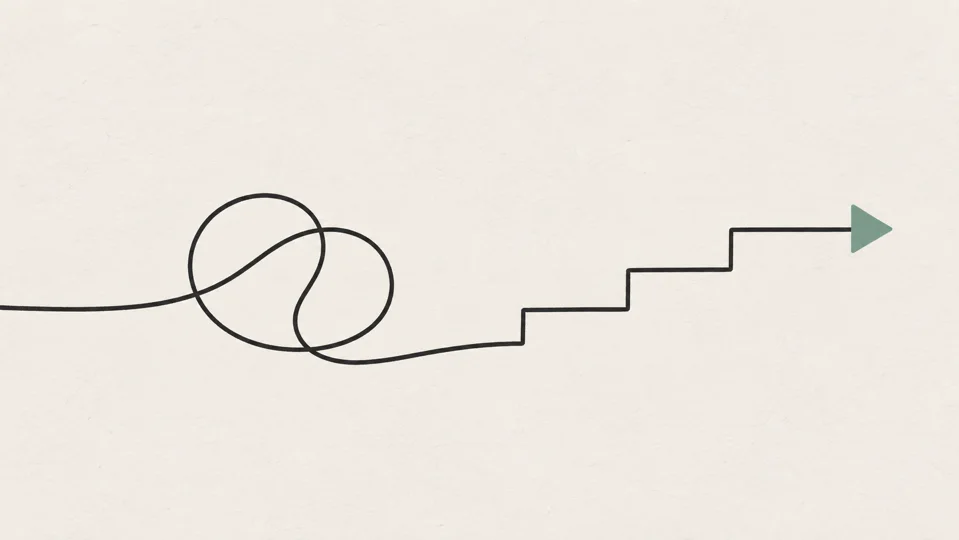
There’s a version of you that almost spoke up in that meeting. You had the idea, it was good, and something in you said “not this time.” The moment passed. Someone else said a weaker version of it ten minutes later and got the credit.
If that stings, you already know the pattern I’m talking about. Most professionals have one. It shows up as the opportunity you didn’t pursue, the decision you kept delaying, the follow-through that collapsed right at the finish line. And the standard advice, be more confident, work on your mindset, just do it, misses what’s actually happening.
A different way to look at self-sabotage at work
Not every stall is a pattern. Sometimes priorities are unclear, the resources aren’t there, or a skill is genuinely missing. But when the same stall keeps happening to a capable person, in situation after situation, something else is usually going on.
Here’s the way I see it: the behavior is not the problem. It is a protection.
The procrastination before the big presentation. The silence in rooms where you have the most to offer. The opportunity you talked yourself out of before anyone else could. These behaviors can be doing a job. At some point, being visible, taking the risk, or wanting more got linked to something painful, whether judgment, rejection, failure, or standing out for the wrong reasons, and some part of you decided it would never let that happen again.
If that’s what’s running, willpower loses. You are not fighting a bad habit. You are fighting a bodyguard. And a bodyguard doesn’t stand down because you bought a new planner.
What these patterns cost a career
Patterns are quiet, and so is what they take. There’s no dramatic failure to point to. There’s the promotion track you never got on because you didn’t raise your hand. The project that stalled because decisions kept waiting for certainty that never came. The relationship with a mentor or sponsor that never formed because reaching out felt presumptuous.
The cost doesn’t show up in any single review. It shows up over years, in the distance between what someone is capable of and what their career actually reflects. And because the pattern is protective, it gets stronger exactly when the stakes get higher. The bigger the opportunity, the louder the “not yet.”
The question that breaks the pattern
The way out starts with a different question. Not “what is wrong with me?” but “what is this behavior protecting me from, and do I still need that protection?”
That question changes everything, because it ends the war with yourself. The behavior stops being proof that you’re broken and starts being information. Procrastination might be protecting you from judgment on finished work. Staying quiet might be protecting you from being seen wanting something. Over-preparing might be protecting you from ever having to find out if you’re actually good enough.
Once you can name the protection, you can thank it for its service and renegotiate its job. That is the actual mechanics of breaking a pattern: not defeating a part of yourself, but updating it.
What changes when the pattern breaks
The goal isn’t to become a different person. It’s to become an unblocked version of the person you already were.
When the pattern loosens, the changes are practical. Decisions can get made on time, because waiting stops feeling safer than choosing. Speaking up becomes possible, because visibility stops feeling dangerous. Follow-through holds more often, because the finish line stops being the scariest part of the project. Opportunities start getting evaluated on their merits instead of through a filter of old alarms.
What changes is that the pattern stops making your career decisions for you. What you build from there is yours.
Who this talk is for
Think about your own team. The high performer who won’t delegate. The emerging leader who won’t take the mic. The talented hire who keeps almost finishing. If any of those sound familiar, your people may be working around patterns nobody has named.
This keynote gives a professional audience the lens to see their own pattern, the language to talk about it without shame, and one question they can use the next morning. It works as a keynote, a breakout, or a workshop, and it’s built for the specific room: what your people are carrying, what your organization needs them walking out with, and what change looks like for them.
Let’s talk about your room
I’m Sage Ratliff, a keynote speaker based in the Denver, Colorado area. If you’re planning an event for professionals, whether a company gathering, an association conference, or a leadership summit, and you want a talk your people will still be using the next morning, use the "Invite Sage to speak" button below. Tell me about your people and what you want to change for them.
The pattern has been making decisions long enough.